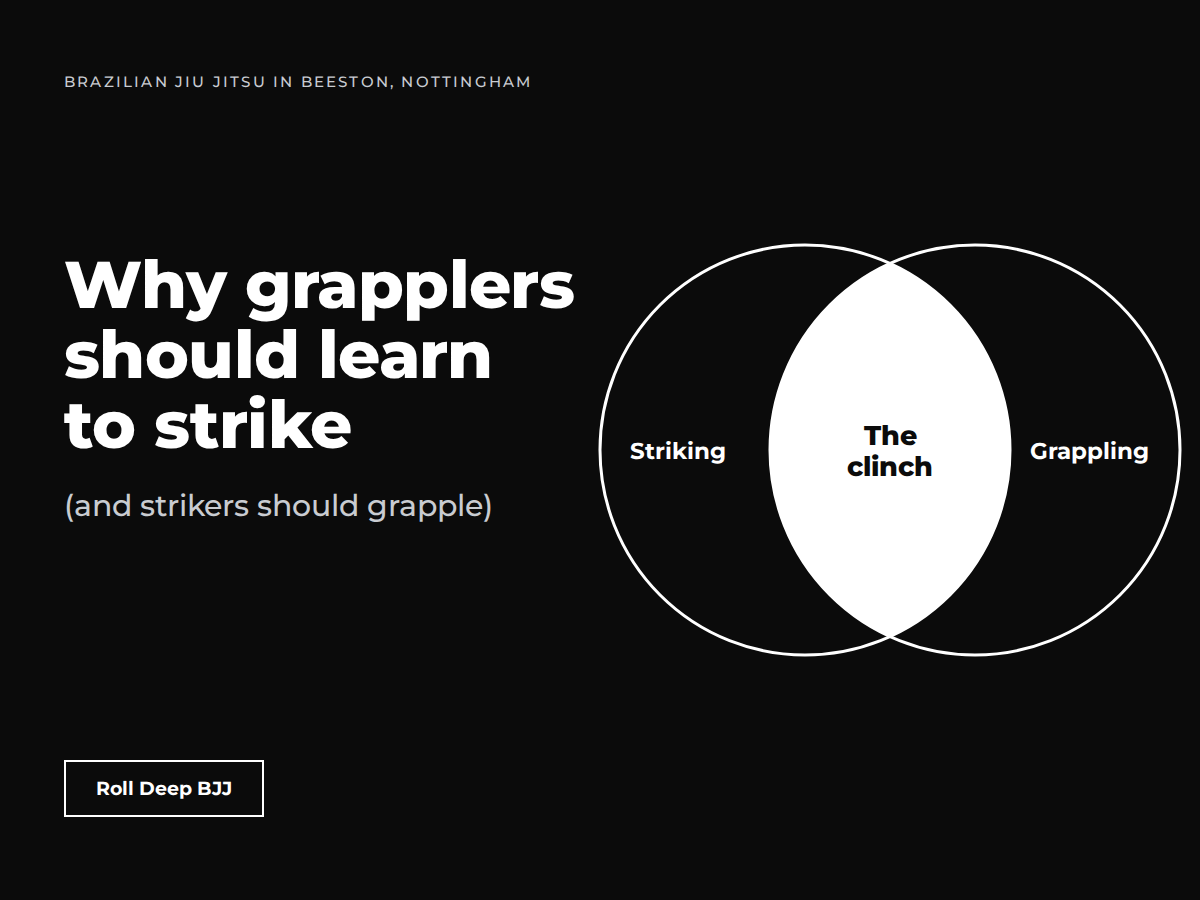
You shoot a takedown in class, but you do it against someone who actually throws jabs. You shoot from the same distance you always do, and their knee meets your face halfway through. Nobody gets hurt, but the problem is clear: you have been timing your entries against people who never punish bad distance. Flip the scenario round and the striker runs into the same wall. They throw a roundhouse kick, get caught, and end up flat on their back without a plan.
Both mistakes stem from the same gap in preparation. It is why we run Saturday Thai boxing classes in Beeston alongside our BJJ sessions. BJJ works fine on its own, and many strikers never need to fight on the mat. However, understanding how the other discipline works makes your own primary style far more effective.
What grapplers get from striking
Most grapplers think striking is just about learning to punch. In reality, it teaches distance control. BJJ and wrestling start inside arm’s reach. Against a striker, the open space between you is where the danger lies, and how you close that distance dictates whether your takedown works.
Work on the pads for a few weeks and your vision changes. You start recognizing kicking range, punching range, and clinch range, as well as how long you linger in each. You realize that shooting a single or double leg from too far out gives your opponent time to react, and dropping your head leaves you open to knees. Practicing basic combinations also shows you how to hide takedowns behind feints and level changes.
These habits pay off even under pure BJJ rules. Reading weight shifts, timing your entries, and moving forward behind a threat make your takedowns cleaner. If you want to refine your stand-up work, our guide on BJJ vs judo vs wrestling breaks down how each grappling style approaches takedowns.
Striking practice also stops you from flinching. Grapplers often hesitate around strikes simply because they are unused to incoming movement. Spending time in front of controlled punches and kicks builds composure. The first few sessions feel awkward when your instinct is to grab rather than cover, but that habit fades with repetition.
What strikers get from grappling
Strikers usually run into trouble when a kick gets caught, when someone slips past the jab into their hips, or when they wind up on the ground. When your striking stops working, panic usually sets in.
Grappling removes that panic through mat time. Going to ground becomes a manageable position rather than an emergency. You learn to sprawl when someone shoots on your legs, secure underhooks to manage posture, and frame to stand back up safely. You also learn how to break your fall properly. Our article on how professional footballers use jiu jitsu for balance covers how base and breakfalls carry over into athletic movement.
Grappling training also refines your stance. It forces you to notice when a kick leaves you off balance, when you overcommit to a jab, or when your feet are too close together. Strikers frequently clean up their footwork once they experience how easily a grappler capitalizes on poor posture.
You can start grappling with zero background knowledge. Our beginners BJJ course in Nottingham teaches core fundamentals step by step, and you can book a free trial session to try a class first.
The clinch: where both arts overlap
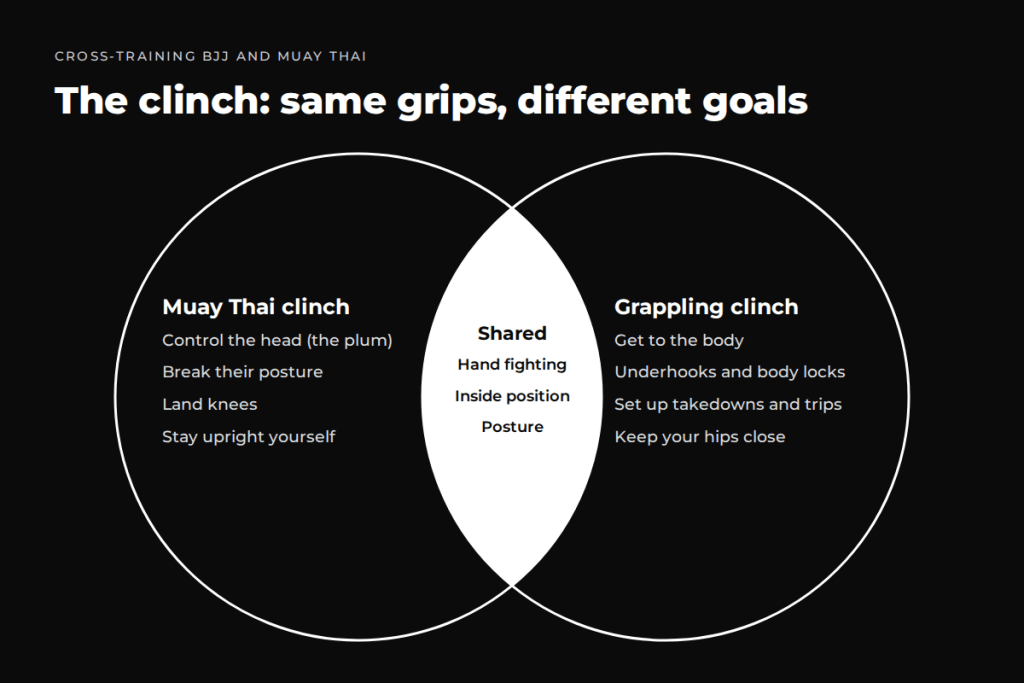
The clinch provides the quickest returns for cross-training. Both martial arts involve hand fighting and body control in close quarters, but they pursue different objectives.
- The Muay Thai clinch. You aim to control the head and break your opponent’s posture to set up knees or sweeps. Locking hands behind the head in the plum position lets you pull them off balance while keeping your posture upright.
- The grappling clinch. You aim to attach to the torso. Collar ties, underhooks, and body locks are designed to drive takedowns or trips, requiring close hips and active footwork.
Training both improves your overall clinch work. Grapplers who practice Thai clinching maintain better head position and resist snapdowns. Strikers who grapple realize the clinch presents takedown risks alongside knee strikes. In both cases, learning grip fighting, elbow control, and inside positioning directly translates between styles.
The honest catch
Cross-training is valuable, but it requires managing your schedule and energy. Consider these points before taking on a secondary martial art:
- Time and fatigue. Adding training volume increases physical demand. If you already grapple four or five days a week, fit striking in by replacing a session rather than overtraining.
- Being a beginner again. Starting a new discipline means resetting your expectations. Adjusting to basic footwork and fundamental movements can feel frustrating after reaching proficiency in another style.
- Slower progress in your main art. Splitting your mat time slows skill acquisition in your primary discipline. If you are preparing for a specific tournament, keep your focus on your main art.
- One class a week has limits. A single weekly striking class complements grappling, but it does not replace a dedicated MMA training camp. Read our comparison of BJJ vs MMA to understand the requirements of multi-sport training.
If you prefer focusing exclusively on sport BJJ or pure striking, stay with your current path. Cross-training is an optional tool for expanding your skill set.
How to do both at Roll Deep
Our Thai boxing session runs Saturdays from 1pm to 2pm at our Beeston gym. It is open to all skill levels and included with standard Roll Deep membership. Head coach Owen Conrad leads the class, bringing over 30 years of experience as a former world kickboxing champion. Details are available on our Thai boxing in Nottingham page.
For grappling, we offer Gi, No-Gi, and dedicated wrestling classes focused on takedowns. Strikers use these wrestling sessions to build takedown defense, while BJJ practitioners use them to improve stand-up entries. Check our timetable for session times and read our full class list for course details.
If you are a striker new to grappling, join the beginners BJJ course before attending open sessions to build correct foundational habits.
Mistakes like getting caught by a knee during a shoot or getting taken down off a caught kick stem from single-discipline training. Cross-training ensures you recognize and address those exchanges before they catch you out.
To start, get in touch to book your first session in BJJ or Saturday Thai boxing.
FAQs
Will learning Muay Thai mess up my BJJ?
No. The main adjustment involves your stance: striking requires an upright posture, whereas grappling uses a lower base. You will quickly learn to transition between the two, and the added understanding of distance improves your takedown timing.
As a striker, should I learn BJJ or wrestling first?
Focus on wrestling if your priority is takedown defense. Choose BJJ if you need to work on guard retention and fighting off your back. We teach both at Roll Deep, starting with the beginners BJJ course.
Do I need to spar to get the benefits of cross-training?
No. Drilling, pad work, and positional sparring develop distance management, posture control, and composure without hard sparring. Speak with a coach before class if you have questions about sparring intensity.