In late 2024, Wolves published a video of their midfielder João Gomes rolling on the mats with UFC lightweight Jai Herbert. The caption on the club’s own channel: “You’ve never seen a Premier League footballer choke a UFC fighter before.” Fair enough, most people haven’t. Gomes is a Brazilian jiu-jitsu blue belt who started training back at Flamengo, and the session in Wolverhampton was set up by the Wolves Foundation alongside Herbert, a Wolves supporter himself. Gomes has since moved on to Aston Villa, but the point stands: a top-flight midfielder chose grappling as his cross-training, and he wasn’t quiet about why.
He told The Sun that “learning Brazilian jiu-jitsu has improved my football”, crediting it specifically with his mobility and flexibility. Before he started, he said, he carried a lot of pain. That’s a fairly unglamorous endorsement, which is probably what makes it believable.

What grappling actually does for a footballer’s body
Football training is very good at producing footballers and surprisingly bad at producing well-rounded athletes. Sprint, decelerate, change direction, repeat, all in roughly the same plane of movement. Grappling attacks the gaps.
- Core strength isn’t sit-ups. Almost every position in jiu-jitsu is an isometric fight to keep your spine and hips organised while someone actively tries to disorganise them. You’re not counting reps, you’re resisting a load that moves and thinks. That’s much closer to shielding a ball or holding off a centre-half than anything a plank will give you.
- Hip mobility under load. Guard retention, shrimping, hip escapes and bridging all take the hip through ranges most gym programmes never touch, and they do it with resistance rather than in a passive stretch. Gomes points to mobility as the single biggest gain he got from it, which tracks.
- Balance in contact. Staying upright with an opponent hanging off you is the entire premise of the standing game. Footballers who grapple tend to describe the same thing afterwards: contact stops feeling like an interruption.
- Learning how to land. This one is undersold. There’s a decent body of research, including Swedish workplace studies on judo-based falling programmes, showing that adults who are taught to break their fall properly get better at it in a matter of weeks and feel more confident on their feet. On a pitch, that’s the difference between a landing and an ankle.
None of this replaces strength and conditioning, and any coach who tells you otherwise is selling something. It complements it, which is a smaller claim but a truer one.
The part that happens above the neck
Gomes has been clear that the physical side isn’t what drew him in. He’s talked about jiu-jitsu as a way of using an opponent’s strength against them, describing it as more about using your brain than your physical strength, and he draws a direct line from that to top-level football, where a huge amount of the game is decided before anyone moves.
That’s the bit recreational athletes tend to underestimate. Rolling with a resisting partner is decision-making under fatigue, with consequences, for five-minute blocks. You get tired, you get put in a bad spot, and you have to choose the next thing anyway. There is no version of that you can fake and no version you can coast through. Do it twice a week for a couple of months and the ordinary pressures of a Sunday league game, a work presentation or a difficult conversation start to register differently.
Mind you, “mental resilience” gets thrown around loosely in fitness marketing. What jiu-jitsu actually trains is narrower and more useful: staying calm when things are going badly and you can’t immediately fix them. That’s a specific skill, and it’s learnable.
The catch, and it’s a real one
Here’s what the highlight reels leave out. Gomes had to put serious jiu-jitsu on hold after his move to England. He couldn’t find a club he trusted, and he was blunt about the reason, saying he needed to be sure he’d come off the mats in one piece because of his football career. He’s also said he avoids training with people new to the sport to reduce the risk of accidental knocks.
So the honest version of the story isn’t “Premier League footballers train jiu-jitsu, therefore jiu-jitsu makes you a better footballer”. It’s that a professional with a multi-million pound contract has to ration something he’s found genuinely useful, and he only does it in environments he can vouch for. Elite sport is a risk-management exercise as much as a training one.
Bixente Lizarazu is the clearest illustration of that. The France left-back won the World Cup in 1998, and only really committed to jiu-jitsu after he retired, taking it up in 2008 and winning the European Open at blue belt in Lisbon the following year, aged 39, before going on to purple. He got the version of the sport Gomes can’t have yet, and he got it because nobody was paying him to stay off the mats.
Which is the bit that should interest you
If you’re a sports fan in Nottingham with a job, a five-a-side habit and a gym membership you resent, you are in a better position to benefit from this than a Premier League midfielder. You have no contract to protect and no fixture list to survive. You can train twice a week, properly, in a room where the coaching is supervised and the pace is controlled. The constraint that limits the professional simply doesn’t apply to you.
What you do need is the environment Gomes was looking for and couldn’t find: experienced coaching, a beginner-appropriate pace and training partners who know how to look after someone who’s learning. That is a genuine variable between clubs, and it’s worth being fussy about.
Starting properly, in Beeston
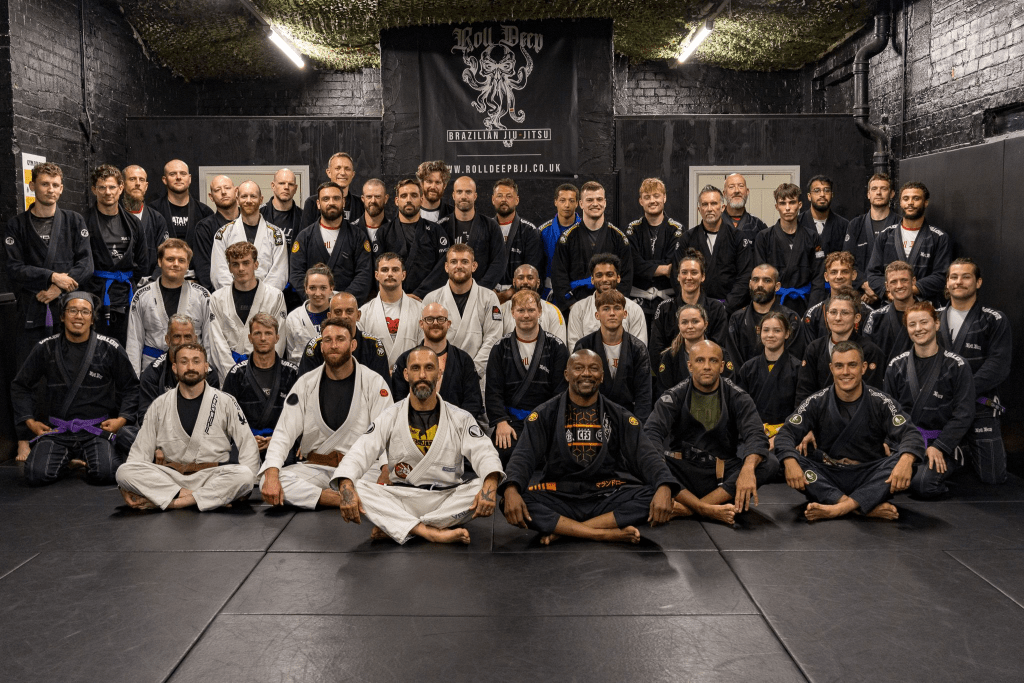
Roll Deep runs a six-week beginners course at our Humber Road academy in Beeston, designed for people who have never set foot on a mat. For total beginners only, so nobody is quietly resenting having to slow down for you.
Six weeks is roughly the point at which most people stop thinking about what they’re doing and start doing it. You’ll have been drilled on how to fall, how to move on the ground and how to hold a position under pressure, and you’ll have had your first honest experience of solving a problem while tired. After that, the full timetable is open to you, including our women-only sessions on Saturdays.
The novelty in that Wolves video was never that a footballer can grapple. Plenty can, and more should. The novelty is how carefully he has to do it, and how little that caution has to do with you.