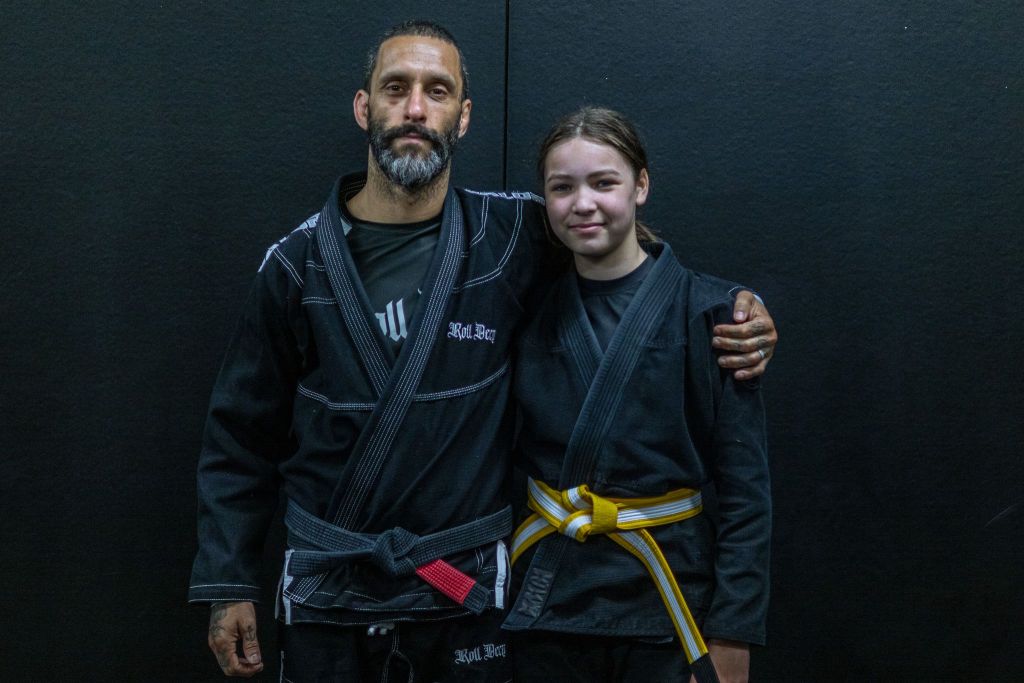
Brazilian Jiu Jitsu for children in Beeston, taught properly
At Roll Deep BJJ, we believe martial arts is about more than just movement; it’s about building a foundation for life. Our “Little Squids” and Teens programs are the premier choice for kids’ martial arts in Beeston, offering a safe, inclusive environment where your child can thrive.

Why Choose Brazilian Jiu-Jitsu for Your Child? (Click to expand)
Brazilian Jiu-Jitsu (BJJ) is a “human chess” game that teaches children how to use leverage and technique rather than brute strength. Our classes focus on:
- Listening Skills & Focus: We teach discipline through structured drills, helping children follow instructions that translate directly to better behavior at school and home.
- Confidence Building: As kids master new techniques and earn their stripes, they develop a “can-do” attitude and the self-assurance to handle life’s challenges.
- Coordination & Fitness: BJJ improves motor skills, balance, and agility, providing a full-body workout that keeps kids active and healthy.
- Discipline for Kids in Beeston: Our coaches emphasise respect—for themselves, their teammates, and their instructors.
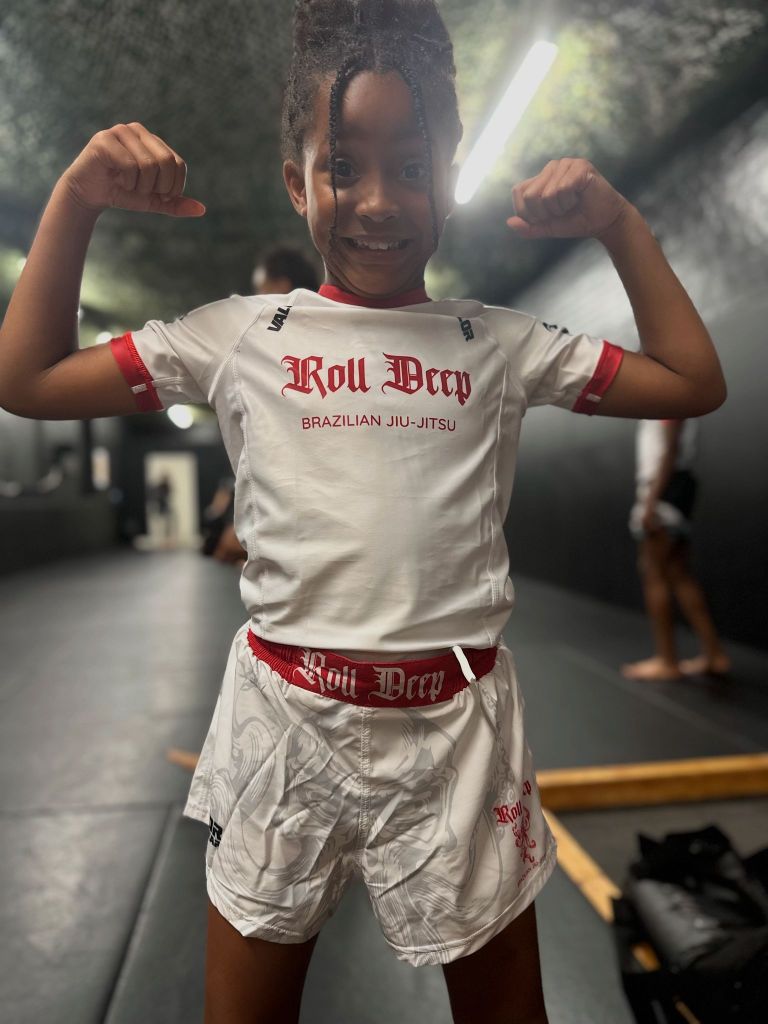
What a Jiu Jitsu class actually looks like (Click to expand)
A session runs an hour and it moves. Children warm up with movement games, drill technique in pairs, and then work live against a partner with a coach on the mat throughout.
That live element is the part worth understanding properly. Jiu Jitsu has no striking, so children can train at full effort safely, which is exactly why it’s one of the few martial arts where a child can genuinely test what they’ve learned against someone resisting. It also means the effort is real. They’ll get tired, they’ll get stuck under someone, and some nights they’ll come off the mats frustrated.
None of that is the class going wrong. It’s the class working.
Your child will lose, and that’s the point (Click to expand)
Brazilian Jiu Jitsu was built on one claim: technique beats size and strength. The whole sport exists to prove that a smaller, lighter person who knows what they’re doing can control a bigger, stronger one who doesn’t.
Which means the first few weeks look like this. Your child, whatever their size, will roll with training partners who are smaller than them, younger than them, or who simply started six months earlier. Those partners will win. Repeatedly. For a child who’s used to being the biggest or fastest in the playground, that’s a genuine shock, and some of them take it hard.
Here’s the thing worth sitting with, though. Every single one of those partners was in exactly that position on their first day. What separates them isn’t talent or size, it’s mat time. When your child understands that, and it usually takes a few weeks, the whole thing flips. Losing stops being a verdict on them and starts being information about what to work on next.
That’s not a lesson you can teach a child by telling them. They have to feel it, and Jiu Jitsu is one of the few places they safely can.
The first three months (Click to expand)
Almost every child hits a wobble. It usually lands somewhere around week four to six, once the novelty has worn off and the difficulty hasn’t. They’ll say they’re bored, or they don’t like it any more, or that someone was too rough, and they’ll ask not to go.
If your child came home and said they hated maths, you wouldn’t take them off the timetable. You’d work out whether something was actually wrong or whether it was just hard that week, and you’d help them through it. Jiu Jitsu is the same, and the wobble is usually the point where the real progress is about to start.
What helps:
- Ask better questions on the way home. “What did you get stuck on?” and “who did you learn something from?” tell your child that a hard session was a useful one. “Did you win?” tells them the opposite, and most of us ask it without thinking.
- Expect a slow curve. Progress in Jiu Jitsu is not linear and it’s rarely visible from the side of the mat. A child can look like they’re going backwards for a month and then suddenly hold their own with someone who used to steamroll them.
- Let them be beginners. Children who are used to being good at things find being a beginner genuinely uncomfortable. Sitting with that discomfort, rather than being rescued from it, is most of the value on offer here.
- Talk to us. If something’s off, we’d far rather have the conversation than have you quietly stop coming. Carlos is on the mat every session and available before and after class.
Push through the wobble and you tend to get a child who’s decided, for themselves, that they can handle hard things. That’s a different kind of confidence to the sort that comes from a participation trophy, and it lasts a lot longer.
Our Kids’ Programs
We run classes for children from age 5 through to 14, split by age and stage rather than by belt, plus mixed sessions that bring the whole group together.
Little Squids (Ages 5–8)
Our youngest group. Fundamental movement, balance and body awareness taught through games, plus the basic positions that everything else is built on.
- Tuesday: 5:00 PM – 6:00 PM
- Friday: 5:00 PM – 6:00 PM
Teens BJJ (Ages 9–14)
A more technical class for older children. Proper Gi Jiu Jitsu, more live training, and a bigger emphasis on building strength and resilience.
- Monday: 5:00 PM – 6:00 PM (Gi)
- Wednesday: 5:00 PM – 6:00 PM (Gi)
All Ages Classes
Open to all kids regardless of age or experience level.
Kids No-Gi (All Ages) A fun, high-energy session for all ages to practice without the traditional uniform.
- Saturday: 10:00 AM – 11:00 AM
Competition Class (All Ages) Our competition class is open to all ages and skill levels — a high-energy session focused on developing sharper technique, live rolling, and competitive readiness.
- Thursday: 5:00 PM – 6:00 PM
Start Their Journey Today
Ready to see the difference BJJ can make in your child’s life? We invite you to bring your child down to our Beeston Academy to meet the team and try a session.